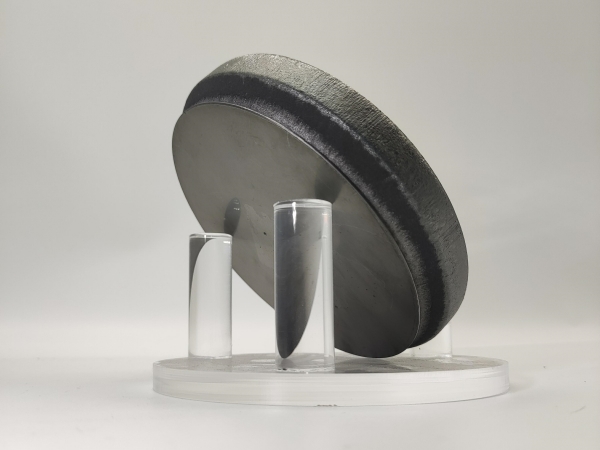
Figure: Typical laser machining of SiC — cutting, ablation and microfabrication.
Silicon carbide (SiC) has emerged as a cornerstone material in advanced power electronics, RF devices, and harsh-environment applications due to its exceptional mechanical, thermal, and electrical properties. However, these same attributes that make SiC attractive—high hardness, brittleness, and chemical inertness—also introduce significant processing challenges. Laser machining has become a leading approach to address these challenges, offering precision, flexibility, and high throughput.
This blog article provides a professional, structured overview of the current state of SiC laser machining, key application areas, process fundamentals, and the technical hurdles that remain.
1. Why Laser Machining for SiC?
SiC’s
material properties (see Table 1) set the stage for why traditional mechanical machining often struggles:
| Property |
Si (Silicon) |
SiC (Silicon Carbide) |
| Hardness (Mohs) |
~7 |
9–9.5 |
| Thermal Conductivity (W/m·K) |
~150 |
~370–490 |
| Fracture Toughness (MPa·m½) |
Moderate |
Low (brittle) |
| Chemical Inertness |
Moderate |
High |
Table 1. SiC vs. Silicon material properties relevant to machining.
Traditional grinding and diamond turning can induce cracks, subsurface damage, and require complex fixturing.
Laser processing—especially with ultrashort pulses—offers a non-contact method that can:
Minimize mechanical stress and micro-cracking
Precisely localize energy to the workpiece
Enable micro-features down to sub-micron scale
Process without consumable tooling
Examples include cutting, drilling, polishing, patterning, and surface functionalization.
2. Laser Machining Fundamentals for SiC
Laser machining of SiC relies on controlled absorption of high-intensity light to remove material via rapid heating, melting, vaporization, or photochemical ablation.
2.1 Beam Parameters
Key parameters that determine process outcome include:
| Parameter |
Impact on SiC Machining |
| Wavelength |
Affects absorption; UV and IR offer different coupling |
| Pulse Duration |
Femtosecond/ps pulses → minimal heat-affected zone |
| Pulse Energy & Repetition Rate |
Affects ablation rate and surface finish |
| Spot Size & Scan Speed |
Controls resolution and throughput |
2.2 Process Regimes
Laser processing typically falls into:
Thermal cutting/ablation — continuous or ns lasers
Ultrafast micro-machining — ps/femtosecond lasers for precision
Surface texturing / functionalization

 Figure: Laser pulse regimes and typical heat-affected zones.
Ultrashort pulse durations dramatically reduce the
heat-affected zone (HAZ) and thermal cracking, making them increasingly preferred for precision work.
3. Primary Applications of Laser Machining in SiC
SiC laser machining has gained traction across several strategic industries:
3.1 Power Electronics & EV Inverters
SiC power devices (MOSFETs, diodes) demand precise dicing and isolation trenches.
Laser cutting reduces chipping and damage compared to mechanical sawing.
Improves yield and throughput in wafer singulation.
3.2 Microwave & RF Devices
Micromachining enables formation of fine features such as
micro-vias, antenna slots, and resonators.
Enables high-frequency performance by minimizing defects.
3.3 Sensors & MEMS
Micromachined SiC structures are used in high-temperature pressure and chemical sensors.
Laser ablation facilitates complex microstructures in SiC MEMS beyond mechanical limits.
3.4 Optical Components & Thermal Management
Laser patterning of SiC aids in fabrication of
diffusers, textured surfaces, and fluidic channels.
Beneficial in high-power optics where polishing is necessary to remove recast layers.
4. Performance Metrics & Typical Outcomes
The performance of laser machined SiC is typically evaluated by:
Surface roughness (Ra)Depth of Heat–Affected Zone (HAZ)Crack densityFeature fidelity (micron scale)
As a simplified benchmark:
| Laser Type |
Typical Ra (µm) |
HAZ (µm) |
Suitability |
| Nanosecond |
0.5–2.0 |
High |
Rough cutting |
| Picosecond |
0.1–0.5 |
Moderate |
Precision features |
| Femtosecond |
<0.1 |
Minimal |
Ultra-precision |
5. Challenges and Limitations
Laser machining of SiC is rapidly advancing, yet several technical challenges persist:
5.1 Thermal Damage and Micro-Cracking
Even with ultrafast lasers, residual thermal stresses can generate micro-cracks. Strategies such as
pulse shaping,
multi-pass scanning, and
optimized beam delivery are often necessary.
5.2 Recast Layer and Surface Integrity
Excessive energy leads to
recast material and resolidified debris, which degrades part performance. Post-processing like chemical etching or polishing is often required.
5.3 Efficiency vs. Precision Trade-off
Higher precision (e.g., femtosecond lasers) often comes at the expense of throughput and capital cost. Balancing speed, quality, and cost remains a practical challenge.
5.4 Process Control & Modeling
Predictive models for SiC laser ablation are still maturing. Real-time monitoring and adaptive control loops are emerging research areas.
6. Future Trends and Innovations
Several promising directions are shaping the future of SiC laser machining:
6.1 Hybrid Processing
Combining
laser + mechanical polishing or
laser + etch workflows to achieve both precision and surface quality.
6.2 AI-Assisted Parameter Optimization
Machine learning models are beginning to predict optimal laser parameters for given SiC geometries and outcomes, reducing trial-and-error.
6.3 Inline Metrology and Feedback
Integration of
optical coherence tomography (OCT) and other sensors enables closed-loop process control for consistent results.
6.4 Scalability for Volume Production
Efforts to design multi-beam and beam splitting optics are underway to increase throughput for wafer-level processing.
7. Conclusion
Laser machining has established itself as a
critical and enabling technology for SiC processing, overcoming many limitations of conventional approaches and enabling next-generation devices in power electronics, RF, MEMS, and optics.
While challenges remain—especially in thermal damage control, surface integrity, and industrial scalability—ongoing innovation in laser sources, process modeling, and hybrid systems continue to expand capability. As SiC adoption grows in
electric vehicles (EVs), renewable energy, 5G communications, and harsh-environment applications, laser machining will remain a core enabler of precision manufacturing.