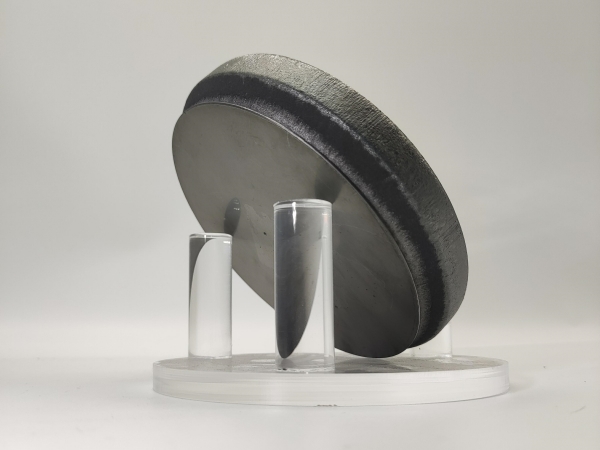
Diamond substrates can be broadly classified into single-crystal diamond and polycrystalline diamond based on their crystal structure. Both types benefit from diamond’s intrinsic advantages, such as ultra-high thermal conductivity and extreme hardness, making them indispensable in semiconductors, optics, and precision manufacturing. However, fundamental differences in crystal arrangement lead to significant divergence in material properties, manufacturing complexity, performance limits, and target application markets.
This article provides a systematic comparison between single-crystal and polycrystalline diamond substrates, clarifying their core differences, market positioning, and long-term development potential.

1. Comparison of Core Material Properties
Single-crystal diamond features a long-range ordered tetrahedral covalent bonding structure with no grain boundaries, whereas polycrystalline diamond consists of numerous randomly oriented diamond grains separated by grain boundaries. This structural distinction directly determines the differences in mechanical, thermal, optical, and electrical performance.
lMechanical Properties
Single-crystal diamond exhibits a Mohs hardness of 10 and a microhardness of approximately 7,000–10,000 kg/mm². Its hardness is anisotropic, with the {111} crystal plane being the hardest. However, it is relatively brittle and prone to cleavage along specific crystallographic planes.
Polycrystalline diamond also has a Mohs hardness of 10, with microhardness typically ranging from 6,500–9,000 kg/mm². Its hardness is more isotropic, and the presence of grain boundaries improves toughness and impact resistance, reducing the likelihood of catastrophic fracture.
The absence of grain boundaries in single-crystal diamond leads to stress concentration and cleavage fracture, while grain boundaries in polycrystalline diamond help disperse stress, enhancing toughness at the expense of uniform hardness.
lThermal Properties
Single-crystal diamond offers thermal conductivity ranging from 1,000 to 2,310 W/(m·K), with high-purity Type IIa material approaching the theoretical limit. Its coefficient of thermal expansion is as low as 0.8 × 10⁻⁶/°C, enabling highly uniform and stable heat dissipation.
Polycrystalline diamond typically exhibits thermal conductivity of 800–1,500 W/(m·K) and a slightly higher thermal expansion coefficient (0.9–1.1 × 10⁻⁶/°C). Grain boundaries introduce thermal resistance, leading to reduced and less uniform heat conduction.
lOptical Properties
Single-crystal diamond provides an ultra-wide optical transmission window from 225 nm to 25 μm, with a theoretical transmittance of up to 71.6%. The absence of grain boundaries eliminates scattering, resulting in low optical loss and excellent optical uniformity.
Polycrystalline diamond offers a similar spectral transmission range, but grain boundary scattering reduces transmittance to approximately 60–70% and degrades optical uniformity, introducing stray light.
lElectrical Properties
Single-crystal diamond has a wide bandgap of 5.47 eV and a breakdown electric field strength of up to 10 MV/cm. Through controlled boron or nitrogen doping, it can exhibit stable semiconductor behavior with uniform dielectric properties and low parasitic capacitance.
Polycrystalline diamond shows comparable intrinsic bandgap and breakdown strength, but grain boundaries tend to form defect states, resulting in non-uniform doping, unstable dielectric behavior, and higher parasitic capacitance.
lChemical Properties
Single-crystal diamond is chemically inert and resistant to non-oxidizing acids, with purity precisely controllable (especially Type IIa material with extremely low nitrogen content). It also shows slightly better oxidation resistance at high temperatures.
Polycrystalline diamond shares similar chemical inertness, but grain boundaries are more prone to impurity adsorption and preferential oxidation at elevated temperatures due to structural defects.
2. Differences in Manufacturing Processes and Technical Characteristics
Both single-crystal and polycrystalline diamond substrates are produced using
High Pressure High Temperature (HPHT) and
Chemical Vapor Deposition (CVD) methods. However, process control priorities, technical difficulty, cost, and achievable product specifications differ significantly. CVD has become the mainstream route for industrial-scale substrate production.
(1) HPHT Process Differences
The HPHT method simulates the natural diamond growth environment. The key difference lies in crystal structure control.
Single-crystal diamond (HPHT):
Precise control of temperature (1,300–1,700°C), pressure (5–7 GPa), and catalyst composition is required. Graphite is used as the carbon source, and diamond seeds guide ordered crystal growth, suppressing polycrystalline nucleation. Equipment temperature control accuracy must reach ±1°C. Growth cycles are long (weeks to months), and products are typically small crystals that require cutting and polishing. Maximum sizes are around 20 mm, with nitrogen impurity levels below 1.2 ppm, though defect rates increase with size.
Polycrystalline diamond (HPHT):
Growth conditions are more tolerant, with wider temperature (1,200–1,600°C) and pressure (4–6 GPa) ranges. Precise crystal orientation control is unnecessary, allowing rapid nucleation and grain growth. Production cycles are shorter (days to weeks), costs are only one-third to one-half of single-crystal diamond, and large-area production is easier, albeit with higher grain boundary defect density.
(2) CVD Process Differences
CVD, especially
Microwave Plasma CVD (MPCVD), is the dominant technology for high-performance diamond substrates.
Single-crystal diamond (CVD):
Ib-type HPHT single-crystal diamond seeds are used, with CH₄/H₂ gas systems and precise control of methane concentration (6–8%), microwave power, and chamber pressure. Small amounts of oxygen (0.4–0.6%) are introduced to improve crystal quality. Secondary nucleation must be strictly suppressed to avoid polycrystalline phases. With AI-assisted process optimization, growth rates up to 12.73 μm/h are achievable, producing high-purity substrates with Raman FWHM as low as 2.96 cm⁻¹. Mass production of 2-inch substrates has been realized, while 3–4 inch wafers are under engineering validation. However, yield remains limited at approximately 52.7%, and unit cost is more than three times that of polycrystalline diamond.
Polycrystalline diamond (CVD):
Polycrystalline diamond does not require single-crystal seeds and can be deposited on silicon, silicon carbide, and other substrates. Methane concentration control is more flexible (4–10%), and crystal orientation control is unnecessary. Large-area and high-speed growth is readily achievable. Using 915 MHz MPCVD systems, 8-inch polycrystalline diamond can be produced in a single run, with growth rates of 15–20 μm/h. Dynamic plasma polishing (DPP) can reduce surface roughness to Ra < 1 nm for 2-inch products. However, edge warpage and global flatness uniformity remain challenging for large-area substrates.
(3) Cost and Technical Bottlenecks
For single-crystal diamond substrates, the main challenges are large-area, low-defect growth and cost reduction. Although domestic MPCVD equipment costs have dropped to one-tenth of imported systems, yield limitations still constrain large-scale adoption.
For polycrystalline diamond substrates, the main bottlenecks are grain boundary defects and flatness uniformity. While cost is low and size scalability is strong, performance ceilings imposed by the crystal structure limit use in high-end applications.
3. Differentiated Market Applications
Performance differences drive clear market segmentation. Single-crystal diamond targets high-end, performance-critical applications, while polycrystalline diamond focuses on cost-sensitive, large-scale markets, forming a complementary industry structure.
(1) Single-Crystal Diamond Substrate Applications
Single-crystal diamond serves niche but high-value markets. In 2023, the global market value of single-crystal diamond substrates for semiconductor applications reached approximately USD 151 million, with a projected CAGR of 12.3% from 2024 to 2030.
Advanced semiconductors:
Single-crystal diamond is the core substrate for GaN-on-Diamond devices used in 5G/6G base stations, quantum computing systems, and aerospace-grade radiation-hardened electronics. Power density can reach three times that of conventional SiC devices. Boron-doped single-crystal diamond supports high-temperature and high-frequency devices for AI chips and electric vehicle power modules. Leading suppliers such as Element Six and Orbray have achieved mass production of 2-inch substrates, targeting 4-inch scalability.
High-end optics:
Single-crystal diamond is used for optical windows, lenses, and prisms in high-power laser systems and deep-space remote sensing. It withstands kilowatt-level laser power without thermal distortion or scattering and is increasingly applied in satellite infrared detection and laser cutting equipment.
Quantum technologies:
High-purity Type IIa single-crystal diamond is the key material for nitrogen-vacancy (NV) center quantum sensors, requiring over 99.99% ¹²C enrichment and achieving magnetic field sensitivity down to 1 pT/√Hz. Applications include neural imaging and inertial navigation, with supply currently limited to a small number of specialized manufacturers.
Polycrystalline diamond addresses broader, cost-driven markets, with cutting tools representing the largest application segment globally.
Thermal management:
Polycrystalline diamond is widely used as heat spreaders and thermal substrates for medium-power electronics such as data center servers, onboard chargers, industrial power supplies, and photovoltaic inverters. Diamond–metal composite substrates offer an attractive balance between performance and cost.
Precision machining:
Polycrystalline diamond is a core material for ultra-hard cutting tools and grinding tools used to machine hard alloys, ceramics, and composite materials. Tool lifetime is typically 3–5 times longer than that of conventional materials.
Mid- to low-end optics and electronics:
Applications include protective windows for high-power lasers, optical components for standard spectrometers, electrode substrates for ozone generation and wastewater treatment, and insulating thermal layers in RF device packaging.
4. Market Competition and Development Trends
lCompetitive Landscape
The single-crystal diamond substrate market is dominated by a small number of high-end suppliers, including Element Six, Orbray (Japan), and leading Chinese manufacturers. While domestic companies have achieved breakthroughs at the 2-inch level, high-end products remain largely import-dependent.
The polycrystalline diamond market is more competitive, with Chinese manufacturers holding a strong position due to cost advantages. Large-area MPCVD systems have enabled mass production of 8-inch polycrystalline substrates, accelerating industrial adoption.
lDevelopment Trends
Single-crystal diamond substrates are evolving toward larger sizes (4–6 inches), lower defect density, and reduced cost, with 6-inch mass production expected around 2026. Penetration in quantum computing and high-end 5G devices is projected to exceed 25%.
Polycrystalline diamond development focuses on grain boundary optimization and flatness improvement, expanding applications in mid-to-high-end thermal management while leveraging large-area scalability for electric vehicles and data centers. Policy support in China continues to accelerate commercialization of large-area CVD diamond technologies.

5. Conclusion
Driven by fundamental crystal structure differences, single-crystal and polycrystalline diamond substrates follow distinct yet complementary development paths. Single-crystal diamond, with its superior uniformity and performance, is indispensable for quantum technologies, advanced semiconductors, and high-end optics, with future progress dependent on breakthroughs in large-area growth and cost reduction. Polycrystalline diamond, supported by cost efficiency and mechanical toughness, enables large-scale applications in precision machining and thermal management.
As manufacturing technologies mature and costs decline, both substrate types will continue to coexist and jointly expand the role of diamond materials across a wider range of advanced manufacturing industries.