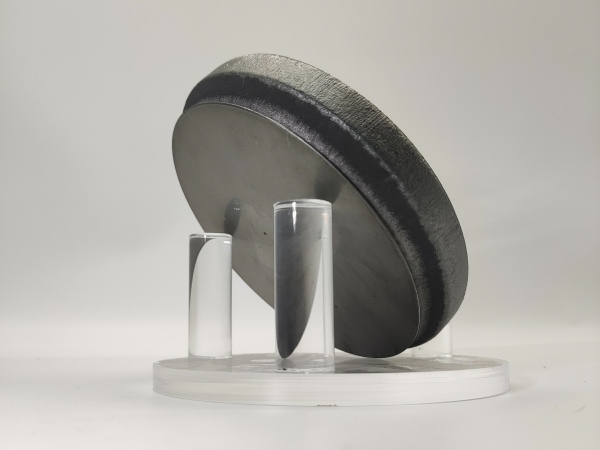
Off-axis sapphire substrates (Off-axis Sapphire Substrate)
Annealing Is a Critical Step in Substrate Preprocessing
Between leaving the factory and entering the epitaxy reactor,
sapphire substrates typically undergo a high-temperature annealing step. This process serves three purposes: first, to remove the damaged layer and contaminants left by surface machining; second, to allow surface atoms to rearrange into a thermodynamically stable, low-energy surface; and third, to obtain the desired step-terrace morphology, providing an ideal starting template for epitaxial growth.
In practical process development, engineers often ask: What annealing temperature should I use? How long should the annealing last? What changes occur for every 50 °C increase? Does doubling the annealing time make the surface flatter? This blog quantifies how the two variables — temperature and time — affect surface morphology, as a reference for process selection.
Temperature: The Master Switch of a Thermally Activated Process
The study compared annealing results of 0° miscut sapphire at two temperature points: 1100 °C and 1350 °C. The two temperatures differ by only 250 °C, yet the difference in surface morphology is qualitative, not quantitative:
| "The effect of temperature variation on morphology is more pronounced than that of time variation, because bunching is a thermally activated process whose rate depends exponentially on the annealing temperature." The physical meaning of this statement is that the mobility of surface atoms follows an Arrhenius relationship — for every tens to a hundred degrees Celsius rise, the atomic diffusion coefficient can increase several-fold or even by an order of magnitude. Step bunching requires atoms to diffuse along the surface, bringing adjacent steps close enough to merge. At 1100 °C, the diffusion coefficient is low and atoms "cannot travel far," so steps remain in place; at 1350 °C, the diffusion coefficient rises exponentially, allowing atoms to easily cross terrace distances of tens of nanometers, and steps naturally begin to move, meet, and merge.
This also explains why studies on sapphire step bunching in the literature mostly cluster in the 1000–1500 °C range: below 1000 °C atoms are essentially immobile, while above 1500 °C excessive faceting and surface roughening may occur. The "onset temperature" for step formation is just above 1000 °C; genuine step bunching and faceting require temperatures above 1300 °C.
| Observed Parameter |
Annealed at 1100 °C (0° miscut) |
Annealed at 1350 °C (0° miscut) |
| Step height |
~0.2 nm single-unit steps (c/6 scale) |
Integer multiples of 0.22 nm, up to 2.4 nm |
| Terrace morphology |
Blurred terrace edges, no sharp boundaries |
Sharp, well-defined terrace edges; width ~120 nm |
| Step bunching |
No bunching whatsoever |
Clear bunching; single steps merge into multiple-step bunches |
| Faceting |
None |
Surface facet nucleation and roughening appear |
| Back-calculated actual miscut |
— |
~0.15° (derived from terrace-width / step-height ratio) |
Time: At 1100 °C, 6 Hours Is Already the "Diminishing-Returns Point"
For the 3° miscut samples, the research team specifically compared the surface state at two time points — 6 hours and 12 hours — at the 1100 °C temperature:
- Step height: 1.5 ± 0.5 nm (6 h) → 1.8 ± 0.7 nm (12 h) — the median increased by only ~0.3 nm, and the statistical distributions nearly overlap.
- Terrace width: 44.2 ± 13.7 nm (6 h) → 43.6 ± 14.7 nm (12 h) — entirely within the error margin; no change.
The conclusion is unambiguous: "At an annealing temperature of 1100 °C, extending the annealing time beyond 6 hours does not appear to produce any further significant change in the average step height or average terrace width."
The reason is that at 1100 °C, although the high initial step density of a vicinal substrate can already undergo preliminary bunching under limited atomic migration — forming step bunches with an average height of 1.5 nm — further faceting, i.e., merging small terraces into larger ones and coalescing short steps into taller ones, requires longer-range mass transport that the atomic mobility at 1100 °C cannot support. No matter how long the time is extended, atoms "cannot travel far," and the surface remains frozen at this steady-state morphology.
For experimental efficiency, the study only extended runs to a few dozen hours. In theory, annealing at 1100 °C for days or even weeks could produce further evolution, but within industrial production timescales (several to a dozen hours), 6 hours is already sufficient for a 3° miscut substrate to reach a steady-state step morphology.

Figure 1. AFM surface morphology of c-plane sapphire after annealing in air at 1100 °C for 12 hours. Compared with the 6-hour sample, the step-terrace structure shows no obvious morphological difference.
Easy-to-Overlook Details in the Annealing Process
Beyond temperature and time, the study also highlights several practical points worth noting:
- Annealing atmosphere and environment: This study used air atmosphere. The surface energy and reconstruction behavior of sapphire differ under various atmospheres (oxygen, vacuum, hydrogen). Under oxygen-deficient conditions at high temperature, a (√31 × √31)R±9 reconstruction phase appears on the surface, which affects the nucleation behavior of subsequent epitaxial films.
- Crucible material and sample placement: The study deliberately used alumina crucibles to reduce contact between impurities released by furnace refractory materials and the surface. In production, if low-grade crucibles are used or samples are placed directly on the furnace floor, the surface may be contaminated by impurities such as silicon or calcium, altering step behavior.
- Furnace temperature uniformity: The study sealed the furnace ends with insulating bricks to maximize temperature uniformity. If the temperature variation across the furnace exceeds ±20 °C, different locations on the same substrate may experience inconsistent annealing results.
- Ultrasonic cleaning sequence: The isopropanol → methanol → acetone sequence is the standard organic cleaning procedure, designed to progressively remove organic contaminants of varying polarity.
Process RecommendationsBased on the experimental data, the following pre-annealing guidelines are recommended for substrate preparation:
| Application Scenario |
Recommended Annealing Recipe |
| Flat, step-free surface needed (noble-metal deposition, catalytic research) |
0° miscut substrate; 1100 °C × 4–6 h is sufficient. No need for longer times, and do not heat above 1350 °C. |
| Well-defined step-terrace structure needed (on 0° substrates) |
Must raise the temperature to 1300–1400 °C. At 1100 °C, step bunching will never occur regardless of time. |
| 3° miscut substrate as step-flow growth template |
1100 °C × 6 h already yields a uniform step structure; extending to 12 h provides no obvious benefit. |
| Wide terraces / tall steps needed (e.g., nanowire directional growth template) |
Higher temperature (>1350 °C) combined with adequate time is required to allow full step bunching and terrace widening. |
| General practice for all recipes |
Use high-purity alumina crucibles; ensure furnace temperature uniformity; allow natural cooling to room temperature before unloading. |
Related Substrates from JXT
To meet pre-annealing needs, JXT supplies
sapphire substrates that have already undergone high-temperature annealing surface treatment (air annealing at 1100–1400 °C; step-terrace morphology can be tailored to requirements), saving customers the effort of setting up their own annealing furnaces. We also supply 2–12 inch SiC substrates (semi-insulating / conductive), silicon wafers (single-side / double-side polished), and fused silica substrates — all available with pre-annealing / cleaning per customer process requirements. For customized annealing services, please contact our technical team to discuss temperature profiles and atmosphere specifications.